

Thursday 21st May 2026 | 11am-12:30pm EAT / 9-10:30am BST
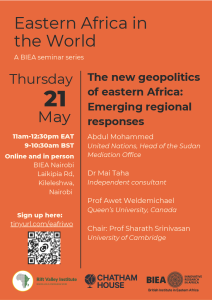
There is widespread recognition that global order is shifting towards multipolar dynamics, with major impact on politics, economics and conflicts in eastern Africa. But how are eastern African leaders and societies responding to and shaping this change? The region’s multilateral bodies, states, and civil societies face new dilemmas, challenges, and opportunities as they seek to assert their various interests and values on the world stage, manage regional dynamics, and shape domestic politics. How they respond will be pivotal in shaping the trajectories for peace and security, economic development, and inclusive politics, as well as influencing the wider reconfiguration of global order. Reacting to this juncture, this public event brings together various leaders and thinkers from eastern Africa to reflect on the present geopolitical changes, the initial responses, and the choices ahead.
Panelists:
- Abdul Mohamed Ababora (Intergovernmental Authority on Development, African Union)
- Dr Mai Taha (Independent consultant)
- Prof Awet Weldemichael (Queen’s University London)
Chair: Prof. Sharath Srinivasan (University of Cambridge)
This event is part of the BIEA’s “Eastern Africa in the World” seminar series. It invites scholars to think about Eastern Africa, broadly defined, as a distinctive yet plurally constituted area-in-the-world. A region too frequently essentialised or fragmented in outsiders’ contradictory and entwined narratives, Eastern Africa lurches between being synonymous with historical absence, calamity and failure and redemptive visions of a techno-optimist ‘Silicon Savannah’ and ever ‘emerging’ promise. Too often, the region’s remarkability is penned reductively from perspectives elsewhere. Yet in its histories, imaginaries, agencies, and connectedness Eastern Africa is a region that has as often written the elsewheres of the world as been shaped by them. This is an intellectual space to think the world from Eastern Africa, and center the scholarly significance of Eastern Africa as world-making through time and across multiple domains.