

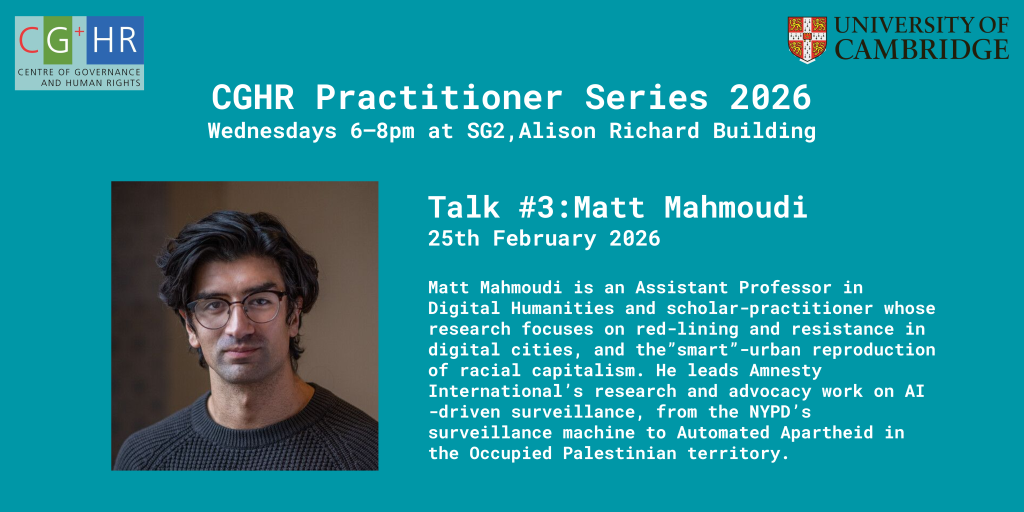
About the Speaker
Dr Matt Mahmoudi is an Assistant Professor in Digital Humanities at the University of Cambridge, with a research focus on red-lining and resistance in digital cities, and the “smart”-urban reproduction of racial capitalism. Matt comes from a scholar-practitioner background, consisting among other things of leading Amnesty International’s research and advocacy work on AI-driven surveillance from the NYPD’s surveillance machine to Automated Apartheid in the occupied Palestinian territory, and teaching ‘Control & Resistance in Digital Societies’ as an Affiliated Lecturer at the Department of Sociology. Matt is also a Research Associate with the Centre of Governance and Human Rights, and an Affiliate Researcher with the DALOSS project at the University of Copenhagen.
He was awarded the inaugural Jo Cox PhD Studentship at the University of Cambridge, where he spent his doctoral research investigating smart cities as new frontiers for migrant violence and digital border control, drawing on the Black radical tradition, critical migration studies, and urban studies. Matt is a co-editor on Resisting Borders & Technologies of Violence (Haymarket, 2024) together with Mizue Aizeki and Coline Schupfer, and further appears in International Political Sociology, and Digital Witness (Oxford University Press, 2020). His first book, titled Migrants in the Digital Periphery: New Urban Frontiers of Controls (University of California Press, 2025) was published in February 2025.
About the CGHR Practitioner Series
The CGHR Practitioner Series runs each year at the University of Cambridge in Lent term, which often features rights activists, aid practitioners and journalists etc. Our speakers relate stories about their own experience — how they came to work in the field that they are in — with details about what the work itself involves. The session thus offers a combination of substantive discussion of the speaker’s work and critical views on the challenges of working in their area, as well as personal and practical insights into how they ended up doing what they do, and how they would advise others thinking about practice.