

Research Theme
Communication Technology and Contentious Politics
See related content
Browse all related content to this research theme.

Lead: Professor Sharath Srinivasan
There is no shortage of contemporary anxiety and debate on the implications of digital technologies for politics: the impact of AI and algorithmic decision-making on bureaucratic and administrative power; the use and abuse of surveillance technologies in the time of COVID-19 and Black Lives Matter; bots, trolls, ‘deep fakes’, disinformation, conspiracy and distorted democracy; the international political economy of hyper-dominant technology companies and a new data colonialism; the commodification of the public realm and ‘surveillance capitalism’; the importance of social media for protest and resistance from the ‘Arab Spring’ to Hong Kong; post-state imaginaries in an age of radical cyberlibertarians … the list goes on.
The disruptive effects of the digital age for politics are apparent for all to see, yet they arise out of a longer history of the complex and dynamic relationship between communication technology and politics. The invention of writing’s relationship to the emergence of bureaucratic power, the age of political reformation and nationalism and the advent of the printing press, global empires and the role of telegraph and broadcast, and now social media and generative AI: communication technologies have played an important role in manifesting and shaping profound political change.
CGHR’s research under this theme uses a historicised approach to the relationship between communication technology and politics to interrogate how authority, power and political contestation are changing in a digital age. Motivating these enquiries is a strong normative purpose: learning recent and past experience, how can we radically rethink civic action and democratic popular sovereignty in our technological present and future?
This work builds on a rich foundation of critical and collaborative research insights. Our work began from an African vantage point. In earlier incarnations of this theme (see ‘Digital Media, Voice and Power’), we saw how the technological transformations taking place across the African continent pose an urgent need for fresh thinking about the nature of socio-political power and its contestation, embedded in longer histories of struggles for voice, justice, dignity and self-determination. Throughout a decade and a half of praxis research, a dozen researchers working with Professor Srinivasan, alongside collaborating scholars, research institutions and social change practitioners, produced a rich array of impactful scholarship and spun out two independent social ventures, Africa’s Voices Foundation and Katikati. Alongside this work, CGHR’s work on online assembly, within a wider project on freedom of assembly, has also been foundational for the contentious politics aspect of this theme. The origins of this work go deeper still, all the way back to CGHR’s inaugural international conference on New Media | Alternative Politics in 2010.
Work on this theme will begin with a foundational project on communication technology and contentious politics in global macro-historical perspective.
See related content
Browse all related content to this research theme.

Related Publications

In Search of a Political Theory of Assembly
Professor Srinivasan’s recently published chapter, in the forthcoming Oxford Handbook of Peaceful Assembly that he co-edits, re-centres the place of assembly in political theory.
Related Articles
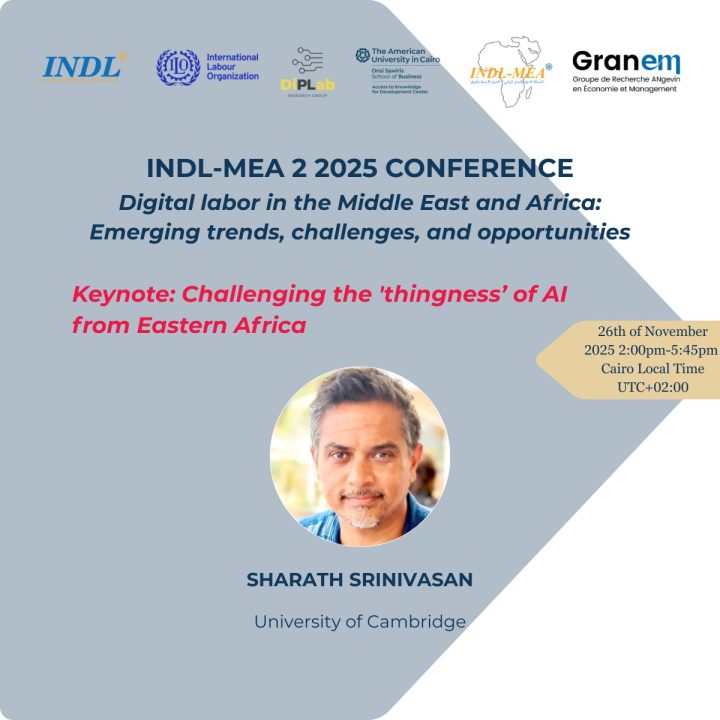
26/11/25
Sharath delivers keynote at INDL-MEA 2 2025 Conference
The keynote, “Challenging the ‘thingness’ of AI from Eastern Africa”, was given at the second International Network on Digital Labor – Middle East and Africa Conference.

25/06/25
Humanities, Social Sciences and AI – Transversal Theme: a Lego Serious Play workshop
On Friday, 3 June 2025, Ella and Sharath convened the first Connections event of the ‘Humanities, Social Sciences and AI’ Transversal Theme: a Lego Serious Play workshop.
20/06/25
Sharath organises panel at ECAS 2025
The panel will focus on the complex trajectories of AI within eastern Africa, in order to interrogate AI’s impacts within lived realities in the region.