

Sharath Srinivasan, CGHR’s inaugural Director (2009-17), is David and Elaine Potter Professor of International Politics in the Department of Politics and International Studies (POLIS) and a Fellow of King’s College. His longstanding research interests are in contentious politics, civic action and normative political theory. These themes animate his areas of research: communication technology, publics and citizen voice; foreign intervention and civil politics in armed conflict; peaceful assembly and civic action. He conducts research primarily in eastern Africa and Sudan and South Sudan. He has been Principal Investigator on multiple major collaborative projects, many with strong practitioner and impact elements. From research at CGHR, he co-founded the non-profit Africa’s Voices, based in Kenya, and went on to co-found Lark Social Impact, builders of innovative communications software Katikati. Sharath’s leadership of CGHR draws on his multidisciplinary training, including an MPhil & DPhil from Oxford University in International Development and undergraduate degrees in Law (human rights, public international) and Economics, as well professional experience coordinating Sudan aid programmes and working in headquarters for the International Rescue Committee, advising governments and implementing agencies on peacebuilding and civic technologies, and previous work in strategy consulting. Sharath is a Trustee and Vice-President of the British Institute in Eastern Africa and a Trustee and Fellow of the Rift Valley Institute. He was previously a Trustee of Africa’s Voices Foundation and served on the executive committee for the Society for the Study of the Sudans in the UK.
Professor Sharath Srinivasan
Co-Director of CGHR

Related Research Projects



Related Publications

CGHR Biennial Report 2022-24
The Centre of Governance and Human Rights’ 2022–24 Biennial Report highlights our activities, outreach and impact.

In Search of a Political Theory of Assembly
Professor Srinivasan’s recently published chapter, in the forthcoming Oxford Handbook of Peaceful Assembly that he co-edits, re-centres the place of assembly in political theory.

Provocations for Human Rights & Technology (2024)
Breaking from big tech, and by working with technology, we are envisioning data, platforms and intelligent systems aligned with pluralism and solidarity.

Peace and Peacemaking in Sudan and South Sudan (2020)
Opening Making and Breaking Peace in Sudan and South Sudan, this chapter introduces thebook’s key concepts: peace and peacemaking. The contributions in this volume show thatideas of peace…

Publics in Africa in a Digital Age
Across Africa, digital media are providing scholars with a reason and opportunity for revisiting the question, and the analytical lens, of publics with new vigour and less normative…
Related Articles

Sharath gives lecture on Sudan’s resistance committees at the University of Manchester
The invited lecture, 'Rethinking resistance: Sudan’s resistance committees during revolution, peace and war', was based on Sharath's own research and collaborative research with Matthew Benson-Strohmeyer and Raga Makawi.
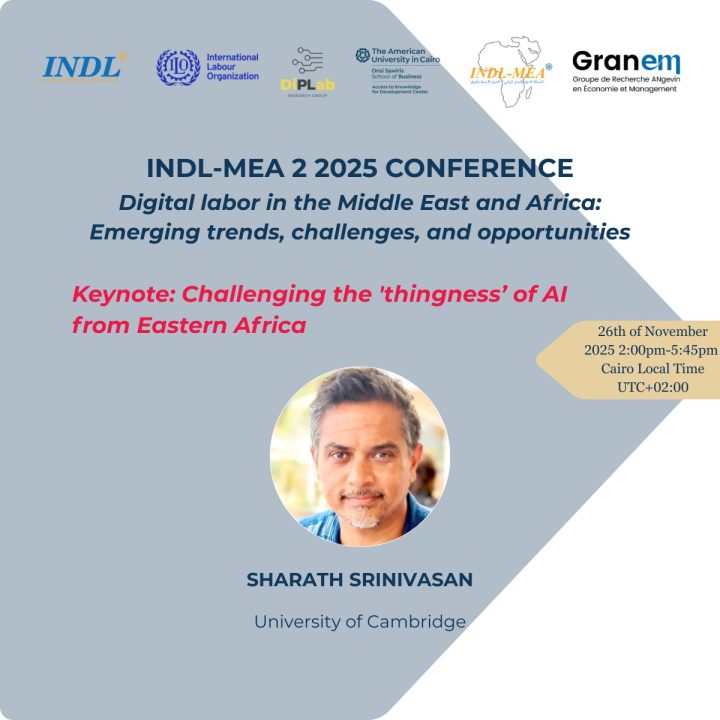
Sharath delivers keynote at INDL-MEA 2 2025 Conference
The keynote, “Challenging the ‘thingness’ of AI from Eastern Africa”, was given at the second International Network on Digital Labor – Middle East and Africa Conference.

Special event with Sudan’s Emergency Response Rooms
A delegation from Sudan's Emergency Response Rooms (ERRs) will be in Cambridge for a special event at King's College Chapel on 26th November 2025.

Sharath shares his insights on Sudan with FRANCE 24
Sharath is interviewed by FRANCE 24 to discuss the latest developments in Sudan's El-Fasher after the paramilitary Rapid Support Forces (RSF) seized the city.

Sharath organises panel at ECAS 2025
The panel will focus on the complex trajectories of AI within eastern Africa, in order to interrogate AI’s impacts within lived realities in the region.