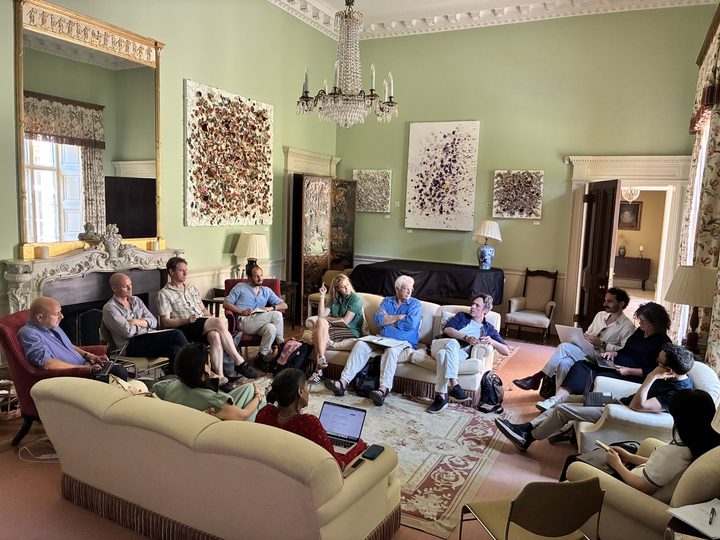
On 9th May, our Postdoctoral Scholar Dr Ashwin Varghese participated in the Tayarisha Writer’s workshop, where he was working on a paper on E-Governance and the Kerala Model: Unpacking the Changing Dynamics of Discretion, Autonomy and Control’ for their second volume.
E-Governance and the Kerala Model: Unpacking the Changing Dynamics of Discretion, Autonomy and Control
Abstract: States in various global south countries are proactively incorporating algorithmic infrastructures in their everyday governance frameworks. While proponents argue that digital transformation makes the state ‘efficient’, critics contend that these infrastructures exacerbate pre-existing biases intensifying marginalisation. These debates hinge on the role of discretion of state personnel and how algorithmic infrastructures – with their promise of automation – rid subordinate personnel of discretionary power, thereby making the systems ‘bias-free’. This paper problematises the understanding of human discretion as corruptible and analyses it in the context of the ongoing development of algorithmic governance in Kerala, India.
The paper primarily focuses on unpacking the changing dynamic of discretion, autonomy and control of state personnel. The state of Kerala, known for the Kerala model of development, a potentially humanist and democratic model of development, has laid out elaborate plans for algorithmic transformation through its e-governance initiatives. Human discretion and autonomy in the frameworks of algorithmic governance are often characterised as biased and partisan. The changing dynamics of discretion and autonomy are not an apolitical transformation. Discretion and autonomy of state personnel, especially in subordinate positions, represent fissures and ‘leakages’ in the model of internal disciplinary control that are inherent to many state systems in postcolonial nations. Drawing from empirical research in India (discourse analysis, content analysis and interviews with state personnel) this paper contributes to debates on algorithmic governance by locating the changing dynamics of discretion, autonomy and control in the emergent politics in global south at the intersection of digital governance and traditional power structures. In doing so, this paper explores whether the state of Kerala in its experiment with digitisation can generate an alternative, humane and sustainable model of algorithmic governance.
On 7 July 2026, the Centre of Governance and Human Rights convened the Cambridge Colloquium on Communication Technology and Politics at the Provost’s Lodge, King’s College.
Ed Parker, Co-Coordinator of the CGHR Student Group, and Tomos Davies, Coordinator of the Digital Verification Corps, came first in their respective cohorts.
We use optional cookies to collect analytics and enable embedded content. By clicking accept, you are giving consent for us to do this. You can find out more in our privacy policy page and manage cookies through the cookie settings page.