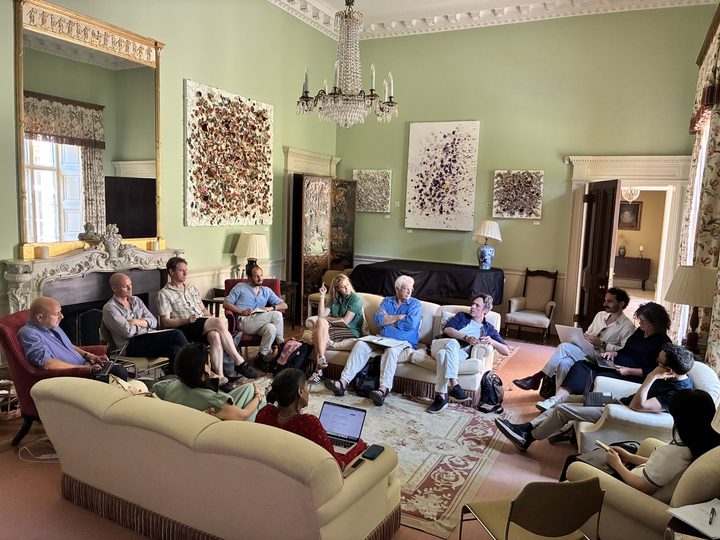
Ashwin presenting at the KCL Symposium on Information Controls
On 16 May 2025, our Postdoctoral Scholar Dr Ashwin Varghese was invited to present a paper on Algorithmic Governance and Postcoloniality: A Case Study of AI Traffic Enforcement Systems in Kerala, India. The Symposium on Information Controls brought together academic and civil society perspectives on information controls from around the world. The event was hosted by the Department of Digital Humanities at King’s College, London with support from the London Arts and Humanities Partnership (LAHP).
Abstract:
Algorithmic Governance and Postcoloniality:A Case Study of AI Traffic Enforcement Systems in Kerala, India
In 2021, the State of Kerala, in southwest India, embarked on a process of digital overhaul of the governance mechanism under its E-Governance policy, integrating ICT, big data, and AI technologies into essential state services, ushering in an era of Kerala’s experiment with algorithmic governance. Drawing from fieldwork in Kerala, in this paper, I take a close look at the indigenously developed AI-powered automated traffic enforcement system. I highlight how states in their specific contexts in the Global South are adopting AI technologies to enable the development of particularistic information control systems. Launched in 2023, the technology is deemed successful in reducing road accidents, as well as increasing the state’s revenue through automatic processing of fines for traffic violations. The E-Governance paradigm outlines a desire to reduce dependency on private enterprises for the implementation of AI systems in the State. In this paper, I critically analyse these claims by unpacking the operational power relations, dominant imaginaries and narratives, by tracing the development of the automated traffic enforcement system. In doing so, I outline the social, political, and economic conditions underlying the creation and implementation of this information control system. In this context, I note how the idea of E-Governance has evolved in the state to respond to concerns about data sovereignty, discretion, agency, and potential harms of AI. For this purpose, I use the framework of postcoloniality as it emerges in critical theory in the Global South to locate contemporary practices. I bring dominant theories of algorithmic governance and empirical realities in conversation with each other to develop critical perspectives on the production and practices of AI technologies and information control systems in the Global South.
On 7 July 2026, the Centre of Governance and Human Rights convened the Cambridge Colloquium on Communication Technology and Politics at the Provost’s Lodge, King’s College.
Ed Parker, Co-Coordinator of the CGHR Student Group, and Tomos Davies, Coordinator of the Digital Verification Corps, came first in their respective cohorts.
We use optional cookies to collect analytics and enable embedded content. By clicking accept, you are giving consent for us to do this. You can find out more in our privacy policy page and manage cookies through the cookie settings page.