

News
How to Make Social Media Social again – Antoine’s Research cited in Institute for Public Policy (IPPR) Research Report
Stuck on you – How to Make Social Media Social Again
Social media has transformed how people communicate, access information and engage with culture and politics. While much attention is given to its harmful effects, including misinformation, polarisation and online safety concerns, its quieter influence on everyday social connections and public life is equally important.
Over the past two decades, social media platforms have shifted from providing greater opportunities for people to share ideas and participate in public conversations to prioritising personalised, algorithm-driven content. This has created a new form of ‘sticky gatekeeping’, where influencers, brands and recommended posts dominate users’ feeds, often at the expense of content shared by friends, family and ordinary members of the public. Research highlights this shift, finding that just 18% of the top posts in users’ feeds came from people they personally knew.
This growing separation between users risks weakening shared experiences, community connections and democratic participation. The paper explores how social media platforms have evolved, the impact this has had on society and the need to make online spaces more genuinely social.
It recommends a combination of stronger regulation, greater prominence for public-interest content, renewed opportunities for community representation through public service broadcasting, and the development of public-service-led social media alternatives that prioritise social benefit over commercial engagement.
The report references Antoine’s recent work (Sander 2025), in which he writes that theorists have ‘sunk into a form of pessimism’, ‘threatening to throw away the democratic potential of the new media environment’, despite the fact that it weakens gatekeepers and allows ordinary people to talk to each other at scale (Sander 2025). He is also noted for suggesting that the democratic and emancipatory potential of social media can be recovered. Similarly, sociologist Paulo Gerbaudo, who has recently given a talk at CGHR, is referenced for noting that the way the online public sphere currently operates shouldn’t lead us to overlook its democratic potential (2022).
Related Articles
02/11/26
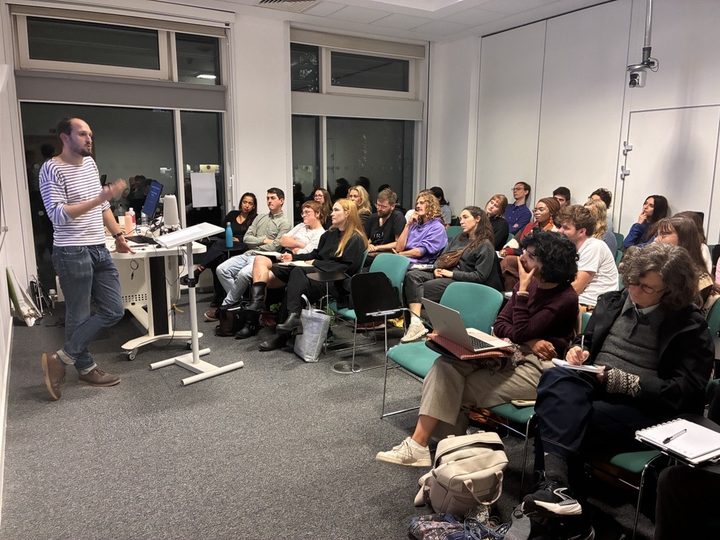
Antoine’s inaugural lecture on “Popular Platforms – Toward a Radical Democratic Theory of Social…
Dr Antoine Sander held his inaugural lecture on the topic of "Popular Platforms - Toward a Radical Democratic Theory of Social Media"
Cambridge Colloquium on Communication Technology and Politics
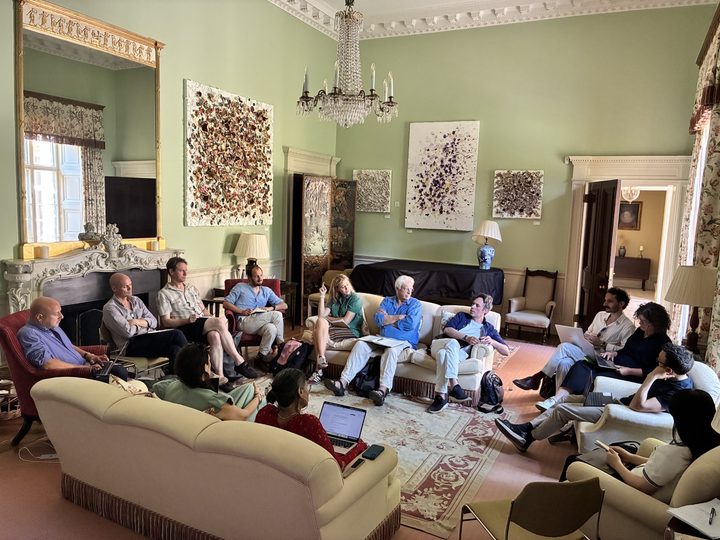
On 7 July 2026, the Centre of Governance and Human Rights convened the Cambridge Colloquium on Communication Technology and Politics at the Provost’s Lodge, King’s College.